
Stem to Market — the pricing pivot, the flat-fee trap, and the B2B pipeline architecture they need to fix.
Blog
This section provides an overview of the blog, showcasing a variety of articles, insights, and resources to inform and inspire readers.
-
Climate Tech Growth Marketing: A Materia Bioworks Pricing Teardown
Key Takeaway: Materia Bioworks, an enterprise biomaterials platform, fixed a flat-fee pricing mistake that was…

Key Takeaway: Materia Bioworks, an enterprise biomaterials platform, fixed a flat-fee pricing mistake that was undercharging its largest enterprise buyers and overcharging small ones, using a three-pillar framework built around cost, revenue, and risk. Their website still has unresolved growth marketing gaps – including an uncaptioned partner logo wall and no conversion tracking on their product page.
Table of Contents
In climate tech growth marketing, few problems are as costly as a company misjudging its own pricing power. Materia Bioworks spent seven years on the hard-tech version of these problems: slow R&D, a fragmented supply chain, and expensive scale-up. They built software to fix it for themselves, and eventually for anyone else stuck in the same loop

MAPS (Materials Application Prediction System) takes the specs of a petroleum-based polymer and generates optimised bioplastic formulations. On the roadmap, not yet live, is a second module meant to act as a digital twin, plugging into factory floor equipment to adjust processing conditions in real time. If it ships as described, it replaces a lot of physical guesswork. No more running endless trials just to see how agricultural waste or a biobased polymer behaves under real production conditions.
Worth flagging for anyone reading this closely: the current product page only shows the formulation tool, a materials library, and a waitlist form. The digital twin is described in Materia’s own MaRS case study as part of the plan, not something a customer can use today. That distinction matters if you are evaluating them as a buyer.
The Go-To-Market Teardown & The Growth Marketing Gap
Who is the buyer? Everyone from multinational food brands to regional cosmetics shops, which is a wide net for a single pricing model to cover. This was exactly where they got into trouble.
The positioning is smart. Co-founder Rajan Manocha put it plainly to MaRS: the goal isn’t to eliminate R&D but to make R&D faster. That is a much easier sell to an engineering team than replacing their workflow, and it lowers the internal resistance a technical buyer would otherwise put up.
They are also running beta tests specifically to generate case studies and proof points ahead of a full product launch later this year. This is smart sequencing. Get the receipts before you ask anyone to pay full price.
So what was their mistake after launching? Pricing. When Materia first went to market, they charged one flat annual subscription fee, regardless of who was buying.
You can’t sell an enterprise biomaterials platform like it’s a basic SaaS tool. A multinational CPG brand running rapid bioplastic formulation through MAPS is pulling millions in value out of it. A regional cosmetics shop is not. One flat number can’t speak both languages, and it definitely can’t speak the language an executive buyer actually cares about: lower cost, new revenue, or reduced risk.
The Fix (Already Underway)
Here is the part that is genuinely worth studying: Materia already fixed this. Last November they brought in MaRS advisor Mike Abramsky, and over three months he built them a framework around five pillars, anchored by an ROI calculator, and helped them segment customers by company size. A large multinational looks nothing like a small cosmetics buyer, and the pricing shouldn’t pretend otherwise. The messaging now ladders up to three things: cost, revenue, and risk.
The fix teaches that if there is still room to push, operationalise it. Materia Bioworks’ new understanding made them venture into calculating a prospect during a sales call and build a tiered pricing structure that reflects the segmentation Abramsky helped them define.
The Site Teardown: What is Actually Working
This site teardown pulled up materiabioworks.com directly rather than working off descriptions, and a few things surprised me.
- Persistent Conversion: The “Get a Demo” button sits in the navigation menu in orange, persistent across every page. It is clear and hard to miss.
- Self-Qualification: The “Are you struggling to integrate sustainable materials…” section does real work qualifying visitors by naming their exact pain points before asking for anything. The three-way split – For Suppliers, For Manufacturers, and For Innovators – lets different buyers self-identify fast instead of reading generic copy and hoping it applies to them.
- The Demo Form: Once you click through, it is well built. It asks for qualifying data like Role, Company Name, and Industry. A rep can tell a Fortune 500 R&D lead apart from a small manufacturer before the first call.
The Growth Marketing Gaps & The Infrastructure Fix
- The Leak: The sub-headline targets broad industries like Food & Beverage instead of actual buyers. Industries do not sign contracts. People do. The website’s top-of-funnel copy is written for an R&D scientist – algorithms, tensile strength, technical specs. But the pricing strategy underneath it is built entirely on boardroom language: cost, revenue, risk. The two don’t match, and that mismatch is exactly where an economic buyer loses interest before procurement ever gets involved.
The Fix (Value-Based Positioning): We rewrite the hero section to bridge the gap between the technical user and the economic buyer. Give the R&D Director the speed and formulation specs they need to do their job. Then, immediately pair it with executive-level messaging – lower supply chain risk and cheaper raw materials – so Procurement actually signs the check.

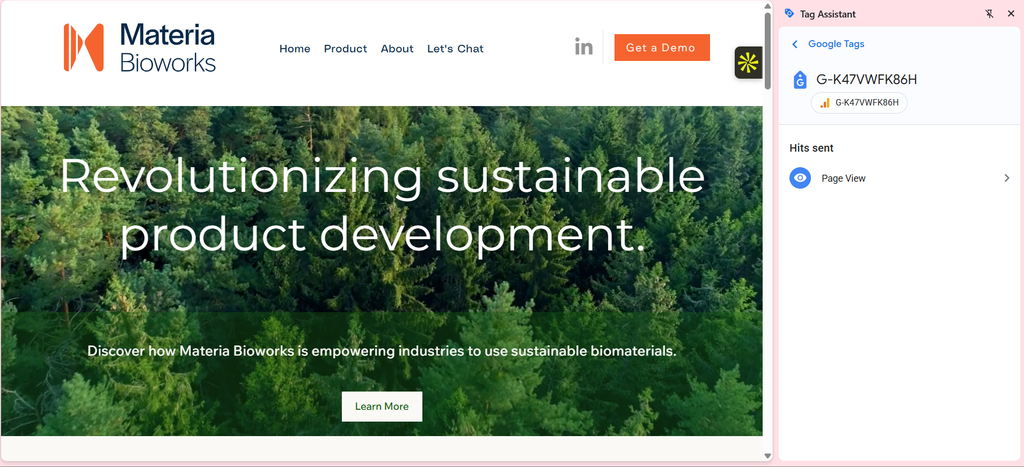
- The Leak: I checked their Tag Manager setup directly. They track basic pageviews across subdomains, which is essentially a vanity metric. There is zero event tracking for high-intent actions, like clicking into the MAPS portal. Sales is flying completely blind.
The Fix (Analytics Data Layer): Implement conversion tags for all high-intent clicks. If you don’t track actual lead-generation events, you don’t have a funnel; you just have a website. A properly configured analytics data layer is a mandatory piece of industrial biotech commercialisation.

- The Leak: The MAPS product page relies on a slideshow captioned “a prototype.” For a technical tool currently in beta, a slideshow of screenshots asks a skeptical buyer to do the heavy lifting of imagining how the software works.
The Fix (Visual Proof): Convert that slideshow into a raw, 60-second screen-recording of the beta actually running a formulation. If a product is “coming soon,” enterprise buyers need to see the engine turning before they hand over their email for a waitlist. - The Leak: The demo form captures Role, Company, and Industry. That is a good start. But knowing a lead’s job title isn’t the same as capturing their intent. When a “Director of Operations” fills out the form, we still don’t know if they are acting as a Sustainability Champion hunting for eco-packaging, or a Manufacturing Gatekeeper worried about factory downtime. Without a specific use-case field, your CRM setup is just an expensive digital filing cabinet.
The Fix (B2B Pipeline Architecture): Map a custom pipeline that automatically segments leads by their specific buying persona and project intent before a sales rep ever picks up the phone. A structured B2B pipeline architecture ensures the R&D Evaluator gets technical specs in their follow-up email, while the economic buyer gets an ROI calculator. - The Leak: Right now, prospects who aren’t ready for a demo are told to “join the waitlist.” Then, silence. In a market with notoriously long sales cycles, leaving that list static is throwing away revenue.
The Fix (Automated GTM Workflows): Build automated communication loops. When a prospect joins, it triggers a sequence that drip-feeds ROI calculators, industry insights, and beta-test metrics. Keep Materia in their inbox while procurement figures out the budget. - The Leak: There are 11 partners on the logo wall on the homepage. A Fortune 500 partnership is mentioned, by their own account. The logo wall backs that up, but the copy sitting directly beneath it still reads ‘Contact us to learn more…’, which undercuts the proof that’s already on the page. There’s a second issue too: to a fast-scrolling buyer, the logos themselves read as venture funds and accelerators (SOSV, IndieBio, MaRS) rather than paying commercial clients, so even the proof that exists doesn’t land as proof of revenue.
The Fix (Trust Architecture): Label those institutional logos accurately as “Innovation Partners.” Then, back up the Fortune 500 claim in a separate section using anonymised commercial metrics, if an NDA (Non-Disclosure Agreement) has been signed (e.g., “Top 3 Global Beverage Brand: Cut formulation time by 40%”).
Commercialising Hard Tech Requires Hard Infrastructure
Materia Bioworks solved the hardest part of the equation: the science. But in enterprise biotech, brilliant engineering will sit on the shelf if the economic buyer cannot easily navigate the digital pipeline.
Venture funding and accelerator logos are enough to get a startup off the ground. But closing contracts with Fortune 500 supply chain directors requires value-based messaging, high-intent event tracking, and an automated B2B pipeline that actually segments leads before the first sales call.
If your climate tech or industrial biotech startup is bleeding enterprise leads, it is not a product problem. It is a pipeline problem.
Subscribe to Stem to Market for climate tech growth marketing teardowns and market intelligence focused exclusively on industrial biotech commercialisation.
Dealing with this exact problem right now? Book a strategy call — we’ll audit your enterprise biomaterials platform and show you exactly where the leads are leaking.
FAQ
How should an enterprise biomaterials company price for different customer sizes?
Segment pricing directly by company size and operationalise it using an ROI framework. Build a tiered pricing structure that calculates the exact value the prospect extracts during the sales call. The final numbers must ladder up to three specific executive outcomes: cost, revenue, and risk. A multinational CPG brand pulls millions in value from rapid bioplastic formulation, while a regional cosmetics shop does not. The pricing architecture must reflect that delta.
Why does flat-fee pricing fail for enterprise SaaS/Biomaterials platforms?
One flat number cannot speak the language of both a global manufacturer and a local supplier. A massive enterprise extracts exponentially more commercial value out of a platform than a regional player. A flat fee either prices out the smaller buyer entirely or leaves millions of dollars on the table during enterprise negotiations. Flat pricing also strips away the ability to anchor the cost to the specific financial outcomes – like supply chain risk reduction or cheaper raw materials – that economic buyers require to justify the budget.
What’s the difference between enablement and disruption positioning in B2B sales?
Enablement accelerates a buyer’s existing workflow; disruption threatens to replace it. Positioning a platform to “make R&D faster” lowers internal resistance because it empowers the engineering team to hit their targets without changing their fundamental processes. Pitching that exact same tool as a way to “eliminate R&D” triggers immediate political friction. Technical buyers will actively block software that threatens their relevance or job security. Enablement gets the technical evaluator to champion the deal to procurement.
Leave a Reply